This is a guest post by Dr Gary Robertshaw of The Green Providers Directory.
The debate surrounding the extent to which the burning of fossil fuels leads to climate change misses a more fundamental point. That is, fossil fuels are an inherently finite resource. This resource is dwindling at an accelerating rate as economies such as those of China and India expand rapidly. Fossil fuels will run out. Maybe not in the next 10, 20 or 30 years but they will run out. As the scarcity of fossil fuels grows there will be increasing conflict between nations to secure their supplies in an effort to maintain their carbon-dependent economies. At the same time, there is an inexorably growing human population, destruction of rainforests, depletion of natural resources and plummeting biodiversity. Clearly, this situation cannot be sustained in the longer-term.
Yet our capitalist system is based on the principle of economic growth – growth that is heavily dependent on fossil fuels and unsustainable practices. Just look at recent events; governments are terrified by anything that threatens economic growth – pouring billions of public money into failing financial systems. In addition, many economists see growth not only as desirable but as essential. They claim it lifts the poor out of poverty, feeding the world’s growing population, supporting the costs of rising public spending and stimulating investment and technological development.
The dilemma is how can we square Earth’s finite resources with the fact that as the economy grows, the amount of natural resources needed to sustain that activity must grow too. I am clear in my conviction that economic growth in its current form is unsustainable. We need a new paradigm that limits (or reduces) the global population, a meaningful shift away from fossil fuels to renewable energy, increasing energy efficiency and the adoption of more sustainable lifestyles. This will require courageous, co-ordinated and global government policies that ensure we don’t use up resources faster than the world can replace them.
Many will dismiss this as a utopian ideology. But isn’t it a utopian ideology to carry on blithely down a path that will ultimately lead to catastrophe? Yes, it will require a new world-view and radical changes but I think we have several grounds for optimism. Firstly, sustainable economies are more stable – whilst growth may be lower than in traditional economies it will be more durable in the longer-term and less volatile. Secondly, the shift towards a sustainable economy would create new opportunities, jobs and greater stability. Thirdly, the potential for conflict between nations is reduced as our dependency on fossil fuels reduces over time. Finally, there is a growing recognition (albeit begrudgingly) amongst governments that the current situation is unsustainable and the mood seems to be shifting from one of cynicism and self-interest to one of genuine commitment to tackling the problem.
The prospect of a truly sustainable global economy, fuelled by renewable energy sources coupled with a stabilised human population and harmonised with biodiversity is an ambitious yet achievable goal. But it’s a goal that requires a re-appraisal of the current meaning of economic growth.
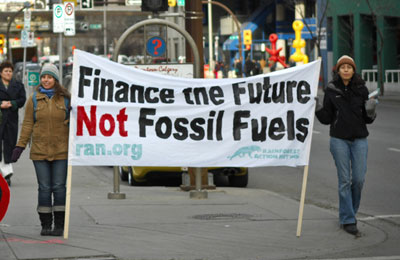
Photo credit: ItzaFineDay
It’s not hard to do this, in fact it’s going to be very hard if we don’t.
The low hanging fruit is conservation though insulation, eff and electric transport.
In 1911 there were Baker Electrics that went 110 miles and Jay Leno’s still has some of the original NiFe batteries!!
I just built an EV trike that gets around 500mpg energy wise and building an 80 mph, 100+ mile range EV sportswagon that will get 200mpg energy wise.
There is no reason zero energy homes can’t be made that produce their own electricity/power as they have been done cost effectively for decades. Some EVer’s power their homes, cars, trucks from solar, wind power now.
I do conservation where my total energy bill is $25-45/month for home, transport at a very low cost initial cost of $35k including the home, land!!
Because of that I don’t have to work much, mostly building custom things in my home shop, and don’t fear the recession, future energy price spikes, ect. I enjoy fishing, sailing and many other things and have time to help others.
So what’s needed is out there for anyone who wants it and all he info online especially in the various RE, EV, ect lists of those who do it daily. It’s your choice, be a slave or be smart, enjoy yourself and help our world at the same time.
there will always a trade off here, and government will always have reason for which one is better.
Our country just continues to amaze me with their horrible planning of the future. If we start on the track of using renewable energy sources and gradually lessen our fossil fuel consumption, we could be on the track of sustainable growth. Right now, the cost of gas seems to have too much of an impact on our economy.
It is not jsut the finite resources of the fossil fuels that is a worry but we also have to consider feeding a population which is growing at an exponential rate on same area of land which we are feeding the current population on. I believe the greater the threat of climate change and lack of natural resources the more siloed we will become, working on micro pockets of sustainable living.
.-= personal insurance´s last blog ..Life Insurance Coverage =-.
Pingback:Why Do We Pay Interest On Borrowed Money?
Pingback:The Wilberforce Award: The Population Puzzle « Neuroanthropology
We need to overhaul our accounting system to reflect the true value of all expendable raw materials, plus clean air and water. At present, for instance, the price of oil does not reflect either its depletion component or its contribution to environmental pollution and degradation. God forbid we should call it a TAX, but it should be a REAL NUMBER in the expense column of every business. Oil that costs $3.50 today at the pump would, in the new system, cost double or triple that amount, reflecting its true value and expense to market. This would reduce profits AND consumption, making all expendable raw materials rather luxurious extravagances and the miners and drillers would not be so inclined to indulge in risky retrieval practices.
We are so good at mathematics and we live in a digital, information and communication technology have had a profound affect on the world but (big but) we seem to miss this point, made so eloquently here. Growth means MORE – but Earth’s resources are finite and economic growth – the holy grail of ALL our Governments whatever their political leaning, cannot work forever – if we achieve economic growth – it just means we consume more and more and eventually consume the whole earth. Is this mankind’s fate? to be the destroyer of Earth? I don’t see it changing.