Skip to content

UK goes mad for nukes

This is a guest post by Pete Roche, editor of the No2nuclearpower website.
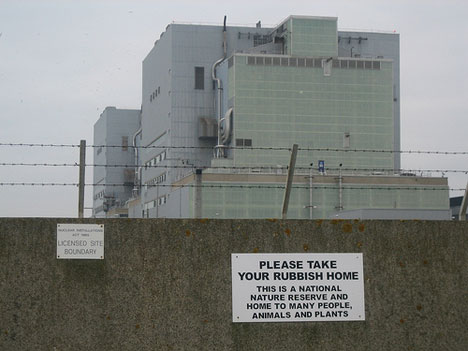
dungeness-nuclear.jpg
Photo credit: Akuppa

There is an episode of “Spooks” – the BBC Spy Drama – in which “green terrorists” threaten to blow up the Thames Barrier and flood London unless the Government releases a report proving it is secretly trying to appear serious about climate change whilst actually continuing with business as usual. Few commentators would be surprised today if they were to learn such a report actually exists.

Friends of the Earth (FoE) and the charity Help the Aged lodged papers at the High Court in London on 9th April seeking a Judicial Review of UK energy efficiency policy because of the Government’s failure to meet its legal obligation to eradicate fuel poverty. People suffering from fuel poverty are defined as those spending more than 10% of their income on heating and lighting. According to the Government’s Fuel Poverty Advisory Group (FPAG), more than 2.3m of the most vulnerable households in England suffer from fuel poverty, which means around eight old people are dying every hour due to cold related illnesses in the winter months.

Britain has plans for ten new “Eco-Towns” and all new houses will be zero-carbon after 2016. But 80% of the houses we will inhabit in 2050 are already built, so, in order to cut carbon emissions by 60%, or preferably 80%, then emissions from these buildings will need to be cut by at least the same amount. Yet current plans expect an entirely inadequate contribution from the domestic sector.
Read More »UK goes mad for nukes

Which textiles are the most eco-friendly?

There’s plenty of hype about organic textiles and their sustainability these days, but are they as eco-friendly as we think they are? I decided to look behind the scenes to find out which fabrics and textiles are truly sustainable and eco-friendly?

Global awareness of the real price of clothing is growing and there are increasing numbers of cases of people experiencing health problems such as rashes, allergies, respiratory and concentration problems due to chemical sensitivities. Many have found organic clothing to be helpful in reducing exposure to the vast amount of toxic chemicals we are unknowingly exposed to on a daily basis.

Cotton vs Organic Cotton

Cotton is a wonderful fibre for making clothes, but it is now recognized that conventionally grown cotton causes great harm both to the environment and to cotton industry workers. Its extensive use of pesticides and insecticides can cause ill-health to people that come into contact with the chemicals and widespread pollution by soaking into water tables. Organic cotton is grown without chemicals and therefore does no harm to either environment or workers, but it is more labour intensive and furthermore fields must be free of chemicals for three years before the crop can be certified organic. There have been huge global increases in the demand for organic cotton and the problem now facing farmers is producing enough to meet the demand. LaRhea Pepper of Organic Exchange says, “In order to encourage long term economically sustainable sources of organic fibre we need to be willing to discuss and implement models that acknowledge the value of the product from the farm gate and continuing right down the supply chain.”
Read More »Which textiles are the most eco-friendly?