Piper and I have been sowing seeds for winter vegetables this afternoon. It’s fun to do with children of any age when outside is stormy and wet, and inside is a much nicer prospect. Northern hemisphere folks sow summer veg… Read More »Rainy Day Kids’ Activity: Sowing winter veg
Down here in the Southern Hemisphere the shortest day of the year less than a week away, and we’re counting down to planting season. Just this past weekend in the rain, my lovely husband was chopping a great chunk out… Read More »Countdown to Planting Season
One Tuesday a few weeks ago I accompanied Duncan Drennan (The Art of Engineering), Duncan’s beautifully pregnant wife Donne, Pia Taylor (Mother City Living), Stefan (a lecturer in applied mathematics at Stellenbosch) and Ruan (a helicopter pilot in training) on a tour of the Fezeka community garden in Gugulethu and the Harvest of Hope packing shed in Phillipi. Both the Fezeka garden (one of many community gardens) and Harvest of Hope form part of the Abalimi Bezekhaya organisation that assists urban farmers to produce food for themselves, their families and communities and to sell their surplus crops.
We started the tour at the BP service station on Rosmead Avenue where we were met by Rob Small, a friendly and enthusiastic man who works tirelessly to bring in funds for Abalimi, as well as running regular Tuesday morning tours of the gardens in a bid to win over more supporters to the project. Rob overflows with passion for the Abalimi project and what it is doing for people in Cape Town’s townships. His enthusiasm is infectious and seeps into everything he says.
Fezeka community garden stands at the foot of a huge pylon
Rob lead the way into Gugulethu and Fezeka, where he explained how 40% of the residents of Cape Town’s informal settlements are unemployed, and where there’s poverty, there is also hunger. The core business of Abalimi is to combat poverty by growing food sustainably (and organically) both at home and in community gardens, and to further green the township areas by planting water wise indigenous trees in the schools and streets of the area. Rob explained that when the Abalimi project started 15 years ago, their aim was to help people achieve subsistence from their growing activities. These days they have surpassed that and are aiming at providing a livelihood for those who before had a hard time even feeding themselves.
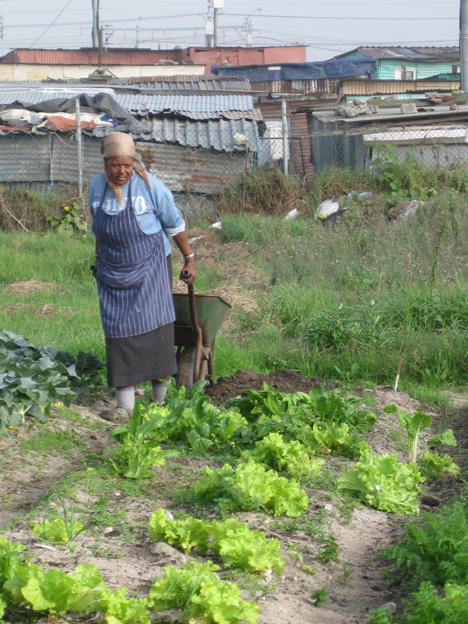
We were shown around Fezeka Garden and met some of the mama’s who run the place. There are very few men involved in growing community gardens on the Cape Flats, the majority of the farmers are women.
Mama Maggie transporting manure to her crops with a wheelbarrow
We were able to take photographs of the gardens and ask Rob questions about how Abalimi facilitates the creation of these food gardens. He explained that Abalimi “subsidises” the farmers to the tune of R150 per farmer per month (that’s around US $15 a month) by providing training, manure and set-up and maintenance of an irrigation system for each garden. This figure is much, much lower than the subsidies provided by government to commercial farmers. Abalimi also helps the farmers gain access to council land and negotiates on their behalf to obtain access to water, for example.
From Fezeka we moved on to the Harvest of Hope packing shed in Phillipi. Harvest of Hope is the marketing and selling arm of Abalimi. They collect the vegetables from the farmers once a week and take them back to the packing shed to wash and prepare for delivery. The vegetables make up weekly organic vegetable boxes that are distributed via some of Cape Town’s southern suburbs schools. (It is possible to buy a Harvest of Hope veg box even if you don’t have children at one of the selected schools, see below for more details).
When Suzanne Forsling moved from the US Midwest to Alaska, she discovered this novel idea for keeping her salad crops off the cold ground and away from critters who messed with them. She used new guttering, but there’s no reason… Read More »Eco-DIY: recycle old gutters into a vertical garden
While most gardeners will agree that the gardening itself is a major part of the pleasure and that the fruits of your labours aren’t everything, there are those who are so busy that they simply don’t have time to plan… Read More »The food garden fairies
It’s times like these when we remember that it’s actually of huge benefit to ourselves to grow some of our own food. So many of us have forgotten that, because it’s “easier” to just pop to the supermarket when we… Read More »Is your garden on the World Food Garden Map?