
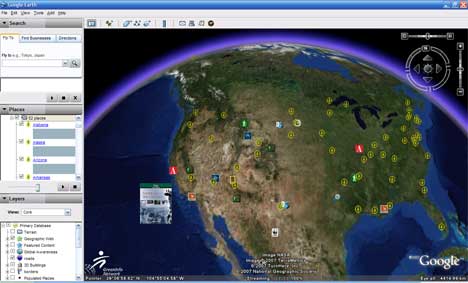
In a part of the world where wild spaces are being threatened by oil and gas drilling, unchecked development, irresponsible recreation, logging, and global warming, the Sierra Club are doing what they can to protect the remains of America’s wild legacy. They have launched a campaign to protect 52 wild places (one in each state, plus one in Puerto Rico and one in the District of Columbia.
From the fragile caribou habitat of Alaska’s Teshekpuk Lake to the wild forests surrounding Oregon’s Mt. Hood, the Sierra Club is working with local communities to protect our last remaining wild lands for future generations.
Preserving our outdoor heritage won’t be easy. Extractive industries and powerful, well-financed special interests have their own designs on these national treasures. Fortunately, more than a century of fighting to protect our land, air, water and wildlife has taught us many lessons in how we can resist these threats. But we must act now to protect our last remaining wild places, because once they’re gone, they can’t be replaced.
Visit these 52 wild locations on Google Earth.
You will need Google Earth to view the above link, to download Google Earth for free, click here.
Pingback:Cartoons Fans Lounge
Is there any way to see it online, as opposed to using Google Earth (eg: the co-ordinates for Google Map).
As a Nebraskan, I greatly appreciate part of our state being brought up as a wild place that the Sierra Club has designated. However, I would take a stand against the particular area of Nebraska they selected. Don’t get me wrong, the Sand Hills are a truly breath-taking area, and everyone should experience them at some point, however, the Sand Hills are also relatively well managed by their private ownership.
The area in Nebraska that is a truly wild area, and an area that is in what I would consider very extreme danger is the Rain Water Basin of Central Nebraska. This area has been gradually diminishing over the years due to encroachment by farming operations, and being drained for irrigation. This area is of vital importance as a stopping point for countless bird species (basically most Migratory waterfowl in N. America funnel into this area one or two times a year as I understand it.) As it shrinks, outbreaks of avian diseases in the increasingly high population areas have the potential to decimate many N. American waterfowl species.
The rainwater basin, while not as picturesque as the Sand Hills is a truly unique area that deserves any protection possible. Of note, the state has been getting more aggressive about conserving this area, as well as other organizations such as Ducks Unlimited, but any additional help would be good.
Pingback:» Visit 52 of America’s wildest places on Google Earth eDollop:
Isn’t the district of columbia already part of the 50 states, so adding an additional one would be redudant…?
My computer can’t open it? Do you need a special program for it?
No DC is not part of the 50 states, thus they have no real representatives in congress, thus their license plates read “Taxation without Representation”
The 52 Most Important Places To Protect Within The Next 10 Years
AL: Upper Cahaba River
AK: The Western Arctic’s Teshekpuk Lake
AZ: San Francisco Peaks
AR: Fourche Creek
CA: Giant Sequoia National Monument
CO: Roan Plateau
CT: Last Green Valley
DE: Prime Hook National Wildlife Refuge
DC: Anacostia River
FL: Western Everglades
GA: Coastal Wetlands
HI: Maha’ulepu
ID: The Owyhee Canyonlands
IL: Shawnee National Forest
IN: Lost River Karst System
IA: The Loess Hills
KS: Haskell Baker Wetlands
KY: Mammoth Cave National Park
LA: Coastal Cypress Forests
ME: 100 Mile Wilderness
MD: Mattawoman Creek
MA: The Middlesex Fells Reservation
MI: Salmon Trout River
MN: Boundary Waters Canoe Area Wilderness
MS: Gulf Islands National Seashore
MO: Mingo National Wildlife Refuge
MN: Great Burn Wild Forest
NB: Sand Hills
NV: Sloan Canyon National Conservation Area
NH: Mount Sunapee Highlands
NJ: Delaware Bayshore
NM: Otero Mesa
NY: Pine Bush Preserve
NC: Pocosin Lakes National Wildlife Refuge
ND: Garrison Reach, Missouri River
OH: Little Miami River
OK: The Glover River
OR: Mt. Hood
PA: Spring Creek Canyon
PR: Northeast Ecological Corridor
RI: Big River Management Area
SC: Savannah River
SD: South Dakota’s Grasslands
TN: Royal Blue Wildlife Management Area
TX: Neches River
UT: Grand Staircase-Escalante
VT: Green Mountain National Forest
VI: Mattaponi River
WA: Wild Sky Wilderness
WV: Seneca Creek Backcountry
WI: Ice Age National Scenic Trail
WY: The Red Desert
Pingback:El Club Sierra y su lucha por salvar la naturaleza de EEUU
Pingback:Top Enviromental News » Blog Archive » Visit 52 of America’s wildest places on Google Earth
The points above are all very insightful, thanks very much.
Pingback:mental_floss Blog » What’s the wildest place you’ve been?
Nice list. Middlesex is about 1 hour from me,, uh oh..lol
.-= John Paul Aguiar´s last blog ..Happy Holidays and My Personal Thank You =-.